
How to Search Court Dockets in Wisconsin
Court level comes first. Circuit cases live in the free Wisconsin Circuit Court Access (WCCA) portal. It searches public case information across the state. Enter a case number or party name. Then add a county filter if you know the filing county. A municipal ordinance ticket may sit with a separate local court. Appeals move through a different statewide system entirely. When the route is unclear, the court printed on a notice or citation is the best first clue.
Once a circuit case appears, note the county and case number. Ask for nothing else until you have those. WCCA summarizes the record but shows no copies of filed papers. The Clerk of Circuit Court in the filing county holds the case file. That office handles inspection, certified copies, and corrections to local case data.
- Choose the court system shown on the notice: WCCA for circuit cases, WSCCA for state appeals, or the named municipal court for a local ordinance ticket.
- In WCCA, begin with a case number or party name. Add the county, case type, or date range only when it helps narrow the search.
- Open the result and note the county, case number, status, dates, and event entries. Check the latest activity rather than relying on a single old setting.
- For the full case file, a signed order, a transcript, or a certified copy, contact the county clerk or other court custodian that holds the record.
No circuit case in the results? The matter may belong to a municipal, appellate, or federal court, or a statutory access limit may apply. An empty result alone proves no court event ever took place.
WCCA Search Fields for Wisconsin Court Cases
WCCA gives you four tools. These are Simple Search, Advanced Search, Judgment Search, and a separate calendar tool. You can search by person or business name, case number, or statewide county. Advanced options layer on dates, case classifications, citation and prosecutor identifiers, and attorney information. One caution applies. The public form does not mark required fields clearly, and some dropdown choices load on the fly. Treat the labels as options rather than guarantees.
| Field or control | Form type | Requirement and use |
|---|---|---|
| County | Dropdown | Required status is not stated. All 72 circuit counties are available. |
| Case Number | Text | Required status is not stated. Copy the number as shown on a court notice. |
| First, Middle, Last Name; Business Name | Text | Search party or business names. Missing-middle-name controls can broaden a match. |
| Date of Birth | Date or text | A search detail; a control can include cases without a stored birth date. |
| Case Type, Status, Class Code | Dropdown or text | Advanced filters. Lists may load dynamically; use the current state classification page. |
| Filing, Disposition, Offense Dates | Date ranges | Advanced filters for the event or offense period. No universal maximum is stated. |
| Citation Number, DA Case Number, Issuing Agency | Text or dropdown | Useful for a circuit traffic or criminal case when those identifiers are available. |
| Attorney Number or Bar ID | Text | Advanced filter for an attorney identifier where applicable. |
For official class names, use the current state case-classification list. WCCA case search has no general "Court" selector, since circuit jurisdiction is organized by county. Calendar search works differently, with a court-official selector whose choices shift based on the county and date you pick.
The Wisconsin Statewide Case Search
WCCA is Wisconsin's public index for circuit-court cases. Consolidated Court Automation Programs (CCAP) backs the case-management system shared by all 72 county circuit courts. The county list therefore reflects one statewide system rather than separate subscription portals. A case record may show the caption, parties, case type and status, court dates, activities, charges, and judgment details. That holds where those fields are public. Internet case search is free, and no attorney filing account is needed.
Coverage has limits, though. Municipal ordinance dockets, federal cases, and state appeals are not all in WCCA. Juvenile, sealed, and other confidential records may be withheld or limited. Older electronic histories have no single guaranteed start date. WCCA is an index and summary, not a repository of online filing images. The Wisconsin case search steps show how to read the results. They also help you pick another route when no public match appears.
The WCCA public case search opens with a statewide circuit-case lookup. Use it to identify a case. The county court remains the source for filings and certified copies.
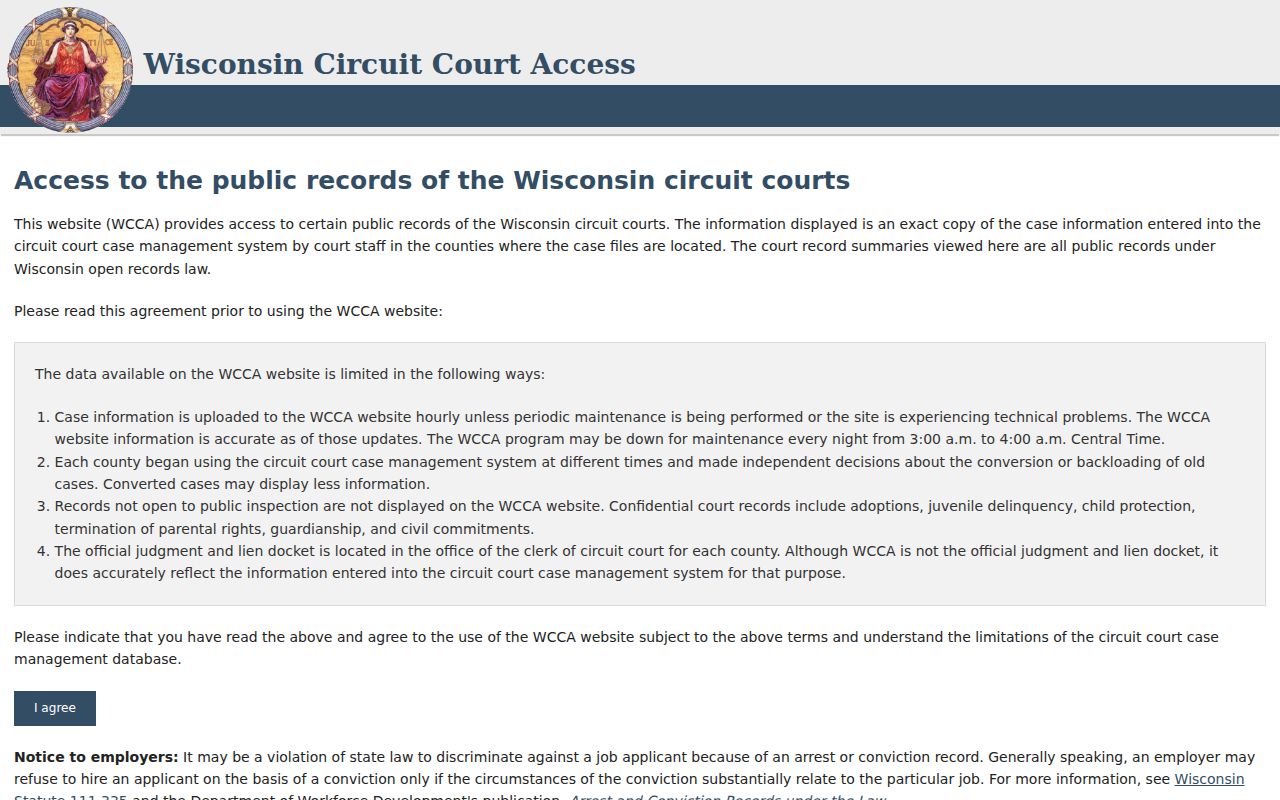
A WCCA result is an index to public circuit-case information. It does not turn municipal, federal, or appellate files into circuit-court records.
Wisconsin Docket Summaries vs. Court Documents
A WCCA "Court Record" entry is a short event description. It is not the text of a motion or judicial order. The case history can show that a paper was filed or an order entered. The paper itself is not an online image in the public case search. A result row may seem to answer a question. The difference matters when you need the actual terms, signature, or evidence.
The Wisconsin Court System's record-access and redaction FAQ lays out the public display limits. It points people seeking filed documents or transcripts to the courthouse in the filing county. A county courthouse terminal can provide WCCA access. Yet that is not the same as inspecting or ordering the local file. The official Wisconsin court record FAQ separates online case information from filed papers.
Need a document, a certified copy, or a missing local entry? The filing county's Clerk of Circuit Court is the source. WCCA can identify the case. It cannot certify the record.
Which Wisconsin Courts Keep Dockets
Wisconsin keeps its trial work at one level: the Circuit Courts, split by county. Each circuit court hears state criminal, civil, family, probate, juvenile, small-claims, and state traffic cases. That reach ends at its borders. Municipal courts sit apart from that system. They are local courts for ordinance matters only. Appeals go up to the Wisconsin Court of Appeals, and sometimes the Wisconsin Supreme Court. Anything federal runs through the federal judiciary's own clerk and search routes. It does not run through the state docket system.
| Court | Docket Covers | Where to Search |
|---|---|---|
| Wisconsin Circuit Court | State trial cases, including criminal, civil, family, probate, juvenile, and state traffic. | WCCA; county Clerk of Circuit Court for the file. |
| Municipal Court | Local ordinance, parking, traffic, and municipal-code cases. | Municipal court directory and the court named on the citation. |
| Wisconsin Court of Appeals and Supreme Court | State appeals and matters within each appellate court's jurisdiction. | WSCCA and the appellate clerk. |
| U.S. District Courts | Federal civil, criminal, and bankruptcy matters. | PACER and the federal court clerk. |
Small claims, juvenile, and probate are not a lower trial tier. They are case categories inside the circuit system. A state appellate case lives in WSCCA, not WCCA, and the circuit file behind it stays with the county where it began.
Wisconsin Municipal Tickets Use Separate Courts
City halls and village boards across Wisconsin can set up their own municipal courts. These handle local ordinance matters. The Wisconsin Court System counted 219 of these courts with 222 judges in its January 2025 report. Joint courts are common too. Seventy-one of them serve anywhere from two to 23 municipalities. Your ticket's court may not match your county at all. Skip the guesswork. Check the citation. The court name printed there, plus the municipality that issued it, will lead you to the right docket far faster than assumptions about geography.
Wisconsin offers no single statewide docket search that covers every municipal citation number. Some municipal courts maintain their own web pages for case lookup. Others simply send you to a clerk or municipal office. The state's municipal court website directory is the practical way to find whichever route your locality uses. Keep WCCA in mind for circuit traffic cases. A local ordinance ticket often lives outside that system.
The volume is striking. The court system reports more than 425,000 municipal cases for 2023. Those come from submissions the judiciary itself says it cannot authenticate. That caseload is enormous and separately run. It is exactly why the statewide circuit portal should never be treated as a universal ticket database.
Wisconsin Court E-Filing Feeds Local Dockets
CCAP supplies the shared technology behind circuit case management and the public WCCA index. Attorneys and other authorized filers submit documents through Wisconsin Circuit Court eFiling. That is a filing system, not a public case-search portal. Once accepted, a filing becomes part of the county court's official case record. Court access and confidentiality rules govern it. The Clerk of Circuit Court still holds the local record. One system powers the statewide view, but the local office keeps the file.
The rollout took years. The Supreme Court adopted mandatory filing rules in 2016. Circuit eFiling then began in 2017. It finished its final circuit case-type phase in December 2019. The Court of Appeals followed with mandatory eFiling in 2021. The Supreme Court joined in 2023, each with stated exceptions. Public search stays separate from all of this, since WCCA requires no filer account. Security upgrades like two-factor authentication apply to eCourts transactions, not to the free public search.
CCAP's official overview explains its statewide technology role. The circuit eFiling page covers who may file and what the requirements are.
Wisconsin Court Dockets Went Online in 1999
Wisconsin's statewide case search did not appear overnight. The Circuit Court Automation Program started planning and pilot work in 1987. Wisconsin Circuit Court Access opened to the public in April 1999. That put circuit case information online for the first time. County integration then rolled in gradually. The 72-county circuit system became fully connected when Portage County joined in 2011.
Those milestones shaped what the modern docket index can and cannot do. Shared CCAP software made a statewide circuit search possible. Yet county courts still receive the filings. They enter case events, preserve the files, and answer document requests. The Wisconsin court system's history of WCCA recounts the launch. Current access rules sit in the public FAQ.
Depth of history varies by court and record category. Electronic coverage depends on when each local conversion happened. A search result is thus not a complete historical archive for every case type.
What a Wisconsin Court Docket Shows
Pull up a Wisconsin circuit case summary. You get most of the public record in one view. What shows up varies with the case type and the access rules attached to it. Expect the county, the case number, the filing date, and the caption. Parties, attorneys, and the assigned branch or official are usually listed too. Case events, court dates, charges, the disposition, and any financial information on file round out the summary. One caution on the interface itself. A tab labeled “Documents” can sit right there on the screen. It may still give the public no image of the actual filing.
| Case number and county | The court's identifier and the county jurisdiction. Preserve the number's letters, year, and sequence as printed on the notice. |
|---|---|
| Parties and attorneys | Names, case roles, and attorney details that are permitted for public display. |
| Case type and status | A broad category and current system status. Read the event history too; a closed status alone is not a full result. |
| Activities or Court Record | Chronological descriptions of filings, hearings, orders, and status changes. They are not the full text of filed documents. |
| Court dates | Upcoming or past scheduled events, when shown. Confirm a current date with the notice or court office. |
| Disposition and judgment | Recorded results, judgment details, and eligible receivable information, depending on case type. |
For the paper itself, whether that is a signed order, a complaint, an exhibit, a judgment document, or a transcript, ask the court that keeps the file for a copy. The docket entry only describes the record. It never replaces it.
Wisconsin Case Codes Explain Record Types
Case-type codes tell you what kind of circuit matter you are looking at in a WCCA result. That is all they tell you. A code marks the filing category. It does not say which party won or what the final order says. Wisconsin updates its classification list over time. Code pages can shift. The live statewide reference beats any frozen chart you might have printed or saved.
- CF and CM
- Felony and misdemeanor circuit criminal case types.
- CT and TR
- Criminal-traffic and traffic-forfeiture case types. They do not cover every municipal ordinance ticket.
- CV
- A broad civil case type; classification codes give more detail about the civil action.
- SC
- Small-claims case type within Wisconsin Circuit Court.
- FA, PR, and JV
- Family, probate, and juvenile categories. Access limits vary, and juvenile files are restricted.
The full set of case and class codes sits in the official Wisconsin circuit classification list. Filtering a docket search by case type works well. Just do not mistake the type for an outcome.
Public Access to Wisconsin Court Dockets
Wisconsin leans toward openness. The state's Public Records Law sets a policy favoring access. Judicial records also answer to court rules, statutes, and court-system policy. For a circuit case, you do not file a generic request with some statewide open-records officer. Go to the county Clerk of Circuit Court. Ask how inspection or copying works there. No single fixed response period applies across the board. The law simply requires covered authorities to act as soon as practicable and without delay.
Not everything is open. Statutes make some records confidential. Protected details get redacted. A judge may seal a file under the court rule. Those limits stand apart from a WCCA display period or a retention schedule. If a case is missing or a field is blank, check with the clerk where the case began. Only the court can rule on a motion to seal.
Key Rules:
Wis. Stat. §§ 19.31–19.39 state Wisconsin's Public Records Law and its access framework.
Wis. Stat. § 801.19 requires protection of listed personal and financial identifiers in circuit filings.
Wis. Stat. § 801.20 identifies court records made confidential by statute.
Wis. Stat. § 801.21 governs a motion to seal; a clerk cannot grant one.
Wisconsin Appeal Dockets Use WSCCA
An appealed circuit case creates a second record path. Wisconsin Supreme Court and Court of Appeals Case Access is the public appellate search for those two courts. It is known as WSCCA. A case view may include the appellate number and the lower court it came from. Status, docket activities, and any briefs, opinions, or orders on file may appear as well. Search by appellate number or party name when you have one. A circuit number alone may not pin down the appeal.
Access to documents turns on filing date and confidentiality. Briefs filed electronically on or after July 1, 2009 are generally available. Older or non-electronic briefs may be harder to reach. Confidential briefs, appendices, and petitions for review stay closed to the public. The original circuit case still sits in WCCA. Its file stays with the county clerk. Federal cases belong to PACER or the relevant federal clerk, not either Wisconsin portal.
Open WSCCA appellate case access for the state appeal. Consult the Wisconsin Court of Appeals for court structure and appellate resources.
Wisconsin Court Dockets and Filing Counts
How busy are Wisconsin courts? The Wisconsin Court System reported 723,647 circuit cases filed in 2024. That figure counts incoming filings, not people, hearings, charges, or cases still pending at year's end. The same statewide fact sheet estimates that criminal matters take 51 percent of circuit court time, civil matters including family and small claims take 34 percent, and traffic, juvenile, and probate share the last 15 percent. Those numbers measure court time, not shares of filings.
A 2025 Judicial Needs Assessment, published in May 2026, applies weighted case time to estimate judicial workload. The court system is explicit that it is not a performance ranking, a backlog measure, or an automatic formula for adding branches. Filings and pending counts answer different questions, so a docket search cannot tell you how fast a case will move.
Wisconsin publishes circuit caseload reports and historical statistics with definitions and cautions. Before comparing case groups, read the year and the measure attached to each figure.
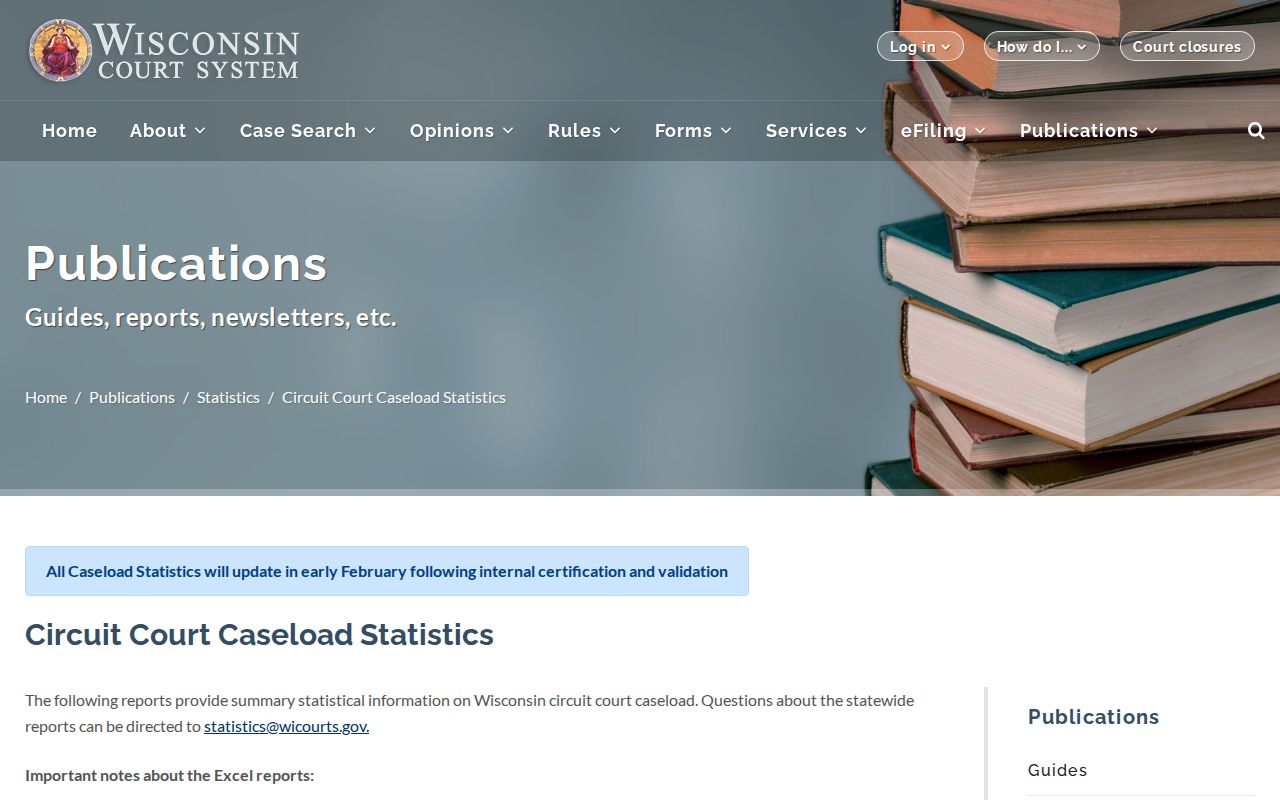
Wisconsin reports annual case openings, dispositions, and pending counts as separate figures. Each one carries its own label and date, so read them before comparing.
Find Court Dockets by County in Wisconsin
A statewide search can identify a public circuit case. But the county Clerk of Circuit Court holds the actual file and can explain inspection or ordering. All 72 local jurisdictions share the statewide index. They still run their own court operations and record counters. If you know the filing county, move straight from WCCA to that local route. When the county is unclear, search the case first and read its county field.
The featured counties here are the ten largest by 2020 Census population. A county-seat label marks the seat itself. The 2024 "opened" number is a local caseload measure. It is not a population count and not a statewide filing total.
Milwaukee County
Seat: Milwaukee · population 939,489 in 2020 · 105,097 cases opened in 2024
Dane County
Seat: Madison · population 561,504 in 2020 · 46,499 cases opened in 2024
Waukesha County
Seat: Waukesha · Milwaukee-area metro · 23,535 cases opened in 2024
Brown County
Seat: Green Bay · northeastern Wisconsin metro · 26,406 cases opened in 2024
Racine County
Seat: Racine · population 197,727 in 2020 · 30,671 cases opened in 2024
Outagamie County
Seat: Appleton · Fox Valley metro · 23,658 cases opened in 2024
Winnebago County
Seat: Oshkosh · Lake Winnebago region · 23,903 cases opened in 2024
Kenosha County
Seat: Kenosha · population 169,151 in 2020 · 22,140 cases opened in 2024
Rock County
Seat: Janesville · population 163,687 in 2020 · 26,991 cases opened in 2024
Marathon County
Seat: Wausau · central Wisconsin regional court center · 12,289 cases opened in 2024
The full directory of all 72 Wisconsin counties leads to each county's court docket site and its local record office.