
The Wisconsin Court System
Wisconsin runs its state judiciary on one unified trial tier: the Circuit Court. These courts handle felony and misdemeanor prosecutions. They also take civil suits, family matters, probate, juvenile cases, small claims, and state-law traffic cases. Every county forms its own circuit-court jurisdiction. Each one has a Clerk of Circuit Court. That clerk maintains the case file and its docket entries. A Register in Probate may handle probate records. Juvenile access follows separate confidentiality rules. Municipal courts, created by cities, villages, or towns, hear local ordinance cases. They are not an extra county-level trial tier.
Two appellate courts sit above the trial level. The Wisconsin Court of Appeals, the intermediate court, works in four geographic districts. The Wisconsin Supreme Court is the court of last resort. Most circuit appeals go first to the Court of Appeals, subject to rules and exceptions. State appeals are searched in WSCCA, while federal cases use PACER. Nine judicial administrative districts back circuit operations. They are separate from the four appellate districts.
The official Wisconsin court-system overview depicts the whole structure. It shows how the Circuit Courts, appellate courts, municipal courts, and statewide administration fit together.
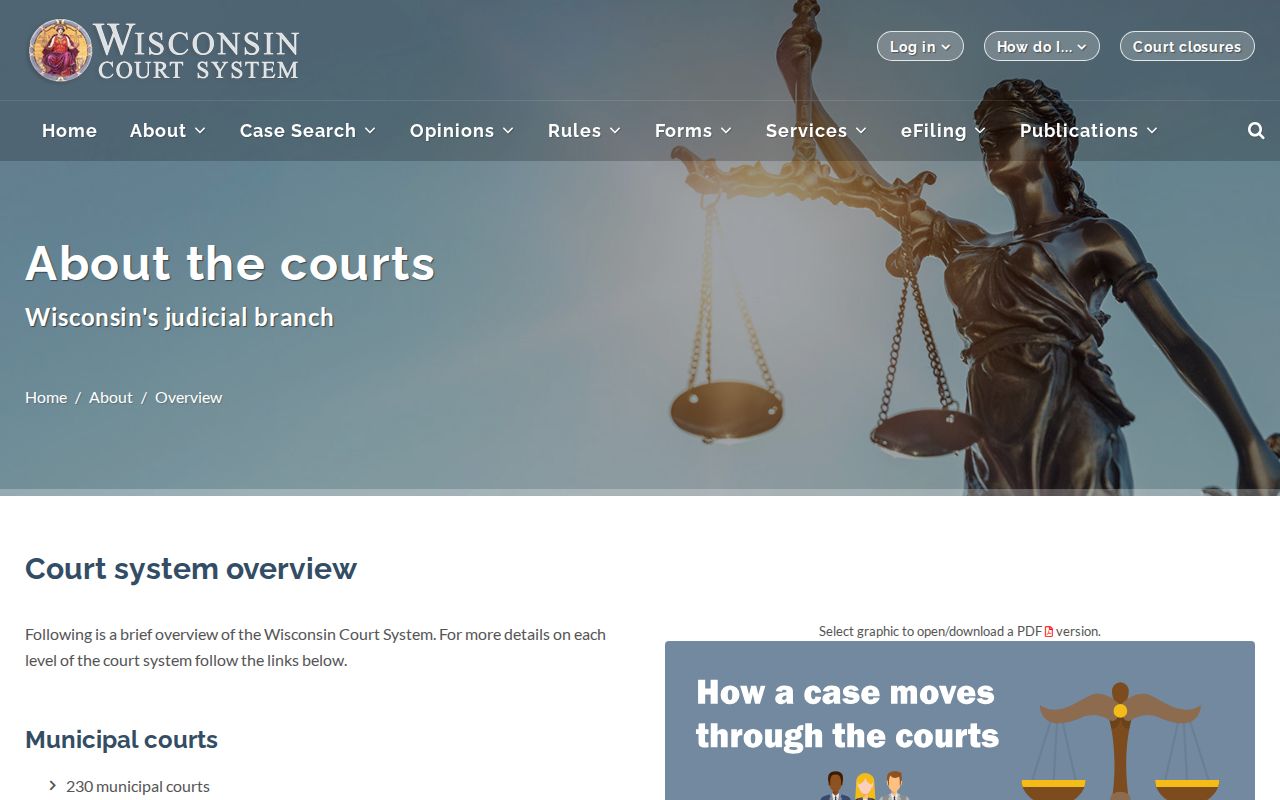
This Wisconsin court hierarchy keeps municipal ordinance cases apart from state circuit cases and state appeals.
Wisconsin Has One State Trial-Court Level
Wisconsin has just one state trial-court tier, the Circuit Court. It is organized into county jurisdictions, not stacked above a separate county court. A circuit case might be a criminal charge. It could also be a civil claim, a family matter, a probate file, or a juvenile proceeding. Small claims and state traffic offenses land there too. Municipal courts handle their own local ordinance cases. They are not a lower state court serving all county residents.
That unified shape makes a statewide circuit search practical. Still, no court file moves into one state office. County clerks keep the circuit records, and municipal clerks hold the local ordinance dockets. A public index can cross county lines while the source record stays local.
The Statewide Case Search Portal
Wisconsin Circuit Court Access (WCCA) is the free public case search for Wisconsin circuit courts. It indexes public case information from all 72 county circuits. The portal runs on the common CCAP case-management system. Search statewide or narrow by county. No county participation filter is needed. When fields are open to display, the portal can return a case summary. It also gives public event history, court dates, charges, and judgment information. The Wisconsin case search page explains its name, number, and advanced search routes.
| Portal Feature | What It Covers | Where It Falls Short |
|---|---|---|
| Case index | Public circuit-case information from all 72 counties. | It does not search municipal ordinance, federal, or appellate dockets. |
| Docket detail | Public case fields and short event descriptions. | An event entry is not the full filed paper or signed order. |
| Documents | Case information can identify filings and orders. | WCCA does not provide online images of circuit filings or transcripts. |
| Updates and history | Current case information and electronic history where available. | No universal refresh interval or start year applies to every record category. |
Confidential matters and protected information never show up as ordinary public search results. When an old case or a document is missing, go to the county clerk for the source file. Do not assume each county runs its own public portal.
CCAP Connects Wisconsin Court Records
Consolidated Court Automation Programs (CCAP) is the Wisconsin court technology program. It supports the shared circuit case-management system, WCCA, appellate access, eFiling, and other court tools. All county circuit courts use it. Its role is broader than a website search. Local court staff work inside the case-management record. WCCA presents a public view of the fields that may be displayed.
The Wisconsin Court System's CCAP overview describes this statewide technology function.
CCAP's shared platform supports one common circuit record. Even so, a clerk's local duties do not disappear. Requests for court papers, certified copies, and corrections still go to the court holding the case file.
How Dockets Flow From County to State
A Wisconsin circuit case starts in the county court with jurisdiction. The clerk processes filings and events in the local case record there. Authorized users may submit through eFiling. Paper filings and other court processes also feed local work. CCAP's common case-management platform supports that record. WCCA then displays public information from it. The statewide view follows access law and display policy. A local file may hold details that never appear online.
Docket flow: Paper filing or Wisconsin Circuit Court eFiling › County court record in CCAP › Public case index in WCCA
WCCA covers circuit cases from all Wisconsin counties. The real gaps fall along court type, confidentiality, and historical availability, not some unintegrated circuit county. Municipal, federal, and appellate records run on different systems. The county directory leads to the local clerk when the full circuit file or an official copy is needed.
Wisconsin Court Administration Runs Statewide
One office in Wisconsin keeps the courts running day to day. Under the Wisconsin Constitution, the Chief Justice heads judicial administration. The Supreme Court created the Director of State Courts Office. Its Director serves at the Court's pleasure. The Director is the top nonjudicial officer. The office handles technology, statistics, court operations, judicial education, and management services. It also works with clerks, judges, and district court administrators across Wisconsin.
That office is administrative only. It keeps no county case files. Take a filing, an appearance, or a copy of any court docket page. The source court is still the place to call. The Director of State Courts Office page explains what the office actually covers.
The Director's Office coordinates judicial operations across Wisconsin. Case files stay with the court that handled them.
Director of State Courts Office
Central administration for court operations, CCAP, statistics, and statewide coordination.
Wisconsin Circuit Court eFiling and E-Filing
Lawyers and other authorized filers can file by computer. Papers go straight into a Wisconsin circuit case. The service is circuit court eFiling. CCAP builds and supports it. The county court receives each filing into the local case record. The Wisconsin Supreme Court made electronic filing mandatory with rules adopted in 2016. Rollout began statewide in 2017 and finished its last circuit case-type phase in December 2019. Covered attorneys generally must eFile, with rule-based exceptions and options for people representing themselves.
A few cautions apply. Filing online does not put every document on public display. The filer works through an authenticated eCourts account. Payment and service steps vary by case. What the public sees follows confidentiality and redaction rules. WCCA stays the public search route, and it needs no filing account. No promise of instant updates covers every case event. The court system's circuit eFiling page explains registration, mandatory use, and how to file.
Wisconsin's eFiling tool submits papers into circuit cases; WCCA public search is a separate service.
Four Wisconsin Appellate Districts Differ
Wisconsin has four Court of Appeals districts and nine judicial administrative districts, and the two sets measure different things. Appellate districts divide the intermediate court's geographic workload. Administrative districts back up trial-court operations and local management. They are not rival appeal maps. A case's county does not shift courts because an administrative district office serves its region.
The Wisconsin Court of Appeals has 16 judges. Most circuit appeals start there. The Wisconsin Supreme Court reviews selected cases and handles matters within its own jurisdiction. The court's appellate structure information details the four appellate districts, their judges, and how the levels fit together.
For a state appeal, search WSCCA. Then check WCCA for the circuit events. The two dockets relate, but each court level keeps its own case history.
Statewide Portal vs County Docket
WCCA finds a public Wisconsin circuit case. It also shows the case's summary fields. The county Clerk of Circuit Court keeps the actual case file. That means the docket history and the filed papers. The clerk can also explain access and copy procedures. Use the county directory to reach the right county office. The split here is statewide public search versus local custody, not participating versus nonparticipating circuit counties.
| Feature | Statewide Portal | County Docket |
|---|---|---|
| Coverage | Public circuit case information across all 72 counties. | The originating county's case file and local court records. |
| Docket detail | Summary fields and short public event descriptions. | Local case history and documents held by the clerk. |
| Documents | No public online images of circuit filings or transcripts. | Inspection or copies may be requested under local access procedures. |
| Certified copies | WCCA search results are not certified copies. | Ask the county clerk for the required copy type and fee. |
Online display limits, sealed records, and retention rules vary by county. So a hit in the index, or a miss, never tells the whole story. Confirm with the county file whether a document exists and whether the public can see it.
Wisconsin Municipal Dockets Stay Local
Municipal courts in Wisconsin handle local ordinance violations, from parking problems to a traffic ticket. Some operate as joint courts. They serve several municipalities, even places that do not share a county border. The Wisconsin Court System listed 219 municipal courts and 222 judges in January 2025. Of those, 71 were joint courts serving between two and 23 municipalities.
There is no statewide municipal case search like WCCA. A local ticket usually names its court or clerk. The state's municipal court directory helps you find that court. More than 425,000 municipal cases were reported for 2023. The judiciary calls those municipal statistics self-reported and unaudited. Municipal ordinance dockets stay separate from the county circuit index either way.
Wisconsin Court Technology and History
Wisconsin's court technology grew up alongside its unified trial-court structure. The circuit court level took shape in 1978. That was the year the Court of Appeals was created. The Circuit Court Automation Program began in 1987. Public WCCA search launched in April 1999. County-by-county integration continued until Portage County joined in 2011. That brought the shared circuit system to all 72 counties.
The filing path digitized after that. Mandatory circuit eFiling rules arrived in 2016, with rollout from 2017 through 2019. Court of Appeals eFiling became mandatory in 2021, and Supreme Court eFiling followed in 2023, each with exceptions in the rules. None of it replaced the county clerk. The clerk remains keeper of the local case record.
The public portal and the county file are two halves of that story. The portal offers statewide access to public case data. Local courts hold the records the index is drawn from.
Wisconsin Court Filings Do Not Equal Backlog
Wisconsin circuit courts took in 723,647 new cases in 2024. That figure counts filings only. Pending matters, by contrast, are a snapshot in time, and dispositions count cases the courts have finished closing out. Treat the three as separate yardsticks. The state also estimates how its court time divides up. Criminal work absorbs 51 percent. Civil matters take 34 percent. Traffic, juvenile, and probate combined take 15 percent. Those are shares of judge hours, not shares of cases.
A Judicial Needs Assessment goes further. Published in May 2026, it uses weighted case time to estimate how much judicial workload the docket demands. It does not rank courts, measure backlog, or hand out branches by formula. Wisconsin's circuit caseload reports walk through each measure and its limits. For the official statewide numbers, the 2024 circuit-court facts sheet is the source to check.