
How to Search Wisconsin Civil Dockets
Wisconsin Circuit Court Access, or WCCA, is the statewide search for public civil cases in the Wisconsin Circuit Courts. Got a case number? Use it first. Otherwise search by a party or business name. WCCA reaches circuit cases in every county, but it does not cover federal claims or municipal ordinance matters.
One caution: a Wisconsin docket entry can locate a pleading, order, or judgment without showing its text. The county Clerk of Circuit Court keeps the case file and handles inspection, copies, and certification. Find the right office through the county directory. See case search for party and number routes.
- Enter the case number or party name in WCCA and select the county if it is known.
- Use the case-type, date, or class-code filters to refine the Wisconsin civil docket results.
- Open the case number and read the newest events, settings, status, and any judgment summary.
- Ask the originating Wisconsin county clerk for filed papers or a certified judgment.
Search Wisconsin Civil Cases in WCCA
WCCA runs on the common Wisconsin circuit case system, giving public civil-case access in all counties. The coverage has limits. Online case detail does not supply copies of complaints, signed orders, exhibits, or transcripts, and confidential categories may be hidden or limited. What the event history shows also depends on record type and when that category entered the electronic system.
Simple Search works by case number or party name. Advanced Search can narrow by county, case type, filing or disposition dates, class code, attorney number, and other fields. Use the live portal for its current dropdown choices. Common fields include:
| WCCA field | Use in a civil search |
|---|---|
| County and party or business name | Finds a case within Wisconsin’s county jurisdiction and listed caption. |
| Case number and case type | Locates the Wisconsin case identifier or narrows to a broad civil category. |
| Filing or disposition date | Limits Wisconsin results to the period when the matter began or received a recorded outcome. |
| Class code and attorney number | Separates a specific Wisconsin civil filing category or links a represented party’s attorney record. |
| Judgment Search | Finds docketed Wisconsin civil judgments by party and judgment filters; it is not a certified judgment copy. |
WCCA search is free and works as a locator; ask the Wisconsin county clerk for filed documents.
What a Civil Docket Shows
A Wisconsin civil case detail can show a lot: the caption, the parties and attorneys, filing date, case type and status, branch or responsible official, dated activity, and upcoming court settings. Judgment fields may list the type and date. Creditor or debtor, amount, and receivable balance may appear where those details are public. Think of the event list as a short procedural history. It shows that a paper or order was entered without reproducing what the filing says.
| Case number and type | Identifies the Wisconsin circuit case and its broad civil category, such as CV. |
|---|---|
| Caption and parties | Names parties and attorneys of record as displayed in the public Wisconsin case detail. |
| Events and settings | Lists dated filings, activity descriptions, and Wisconsin hearing dates. |
| Status and disposition | Summarizes whether a case is open or closed and records case or claim outcomes. |
| Judgment and receivable | May show a judgment heading, amount, or balance without the signed judgment’s terms. |
In Wisconsin, a “Judgment entered” event is not the judgment itself. The complaint, order, and transcript remain separate papers in the county case file.
CV, SC, FA, and PR on Wisconsin Civil Dockets
Case type and class code are different labels. The broad type may read CV for civil, SC for small claims, FA for family, or PR for probate. A numeric class code narrows CV to a kind of claim, such as a money judgment, contract, personal injury, foreclosure, or municipal-court appeal. Neither label is a ruling on the merits.
- CV
- Wisconsin circuit-court civil case category, with more specific class codes beneath it.
- SC
- Wisconsin small-claims case type within the circuit court system.
- FA
- Wisconsin family case category, including divorce and other family proceedings.
- PR
- Wisconsin probate case category; probate duties may route through a Register in Probate.
The current classification list from the Wisconsin court system is the place to check, since the list is extensive and can change. A Wisconsin public record may show both a broad type and a specific class.
Note: A Wisconsin civil case code describes how a filing is classified, not whether a party won or lost.
Types of Civil Cases on the Docket
Wisconsin Circuit Courts hear general civil claims along with family, small-claims, real-estate, probate, and related proceedings. The WCCA case type tells you the broad track. A more specific class code may identify a contract dispute, injury claim, foreclosure, guardianship, or estate. A civil appeal from a municipal judgment creates a circuit record. The original local court record stays separate.
| Wisconsin civil track | Examples in the case record | Access point to check |
|---|---|---|
| General civil | Contract, money judgment, tort, property, or foreclosure | WCCA and the circuit court case file |
| Small claims | Qualifying money claims, tort claims, eviction, or replevin | WCCA; Chapter 799 and the current class list |
| Family and probate | Divorce, paternity, estate, trust, or guardianship | WCCA where public; county clerk or Register in Probate for records |
| Municipal appeal | Appeal from a local municipal-court judgment | Separate municipal record and new circuit appeal case |
These tracks all belong to Wisconsin’s Circuit Courts, though probate, juvenile, and family records may have different custodians or access limits. Unappealed municipal ordinance cases remain local records.
The official Circuit Court overview sets out where Wisconsin civil matters sit in the state trial-court system.
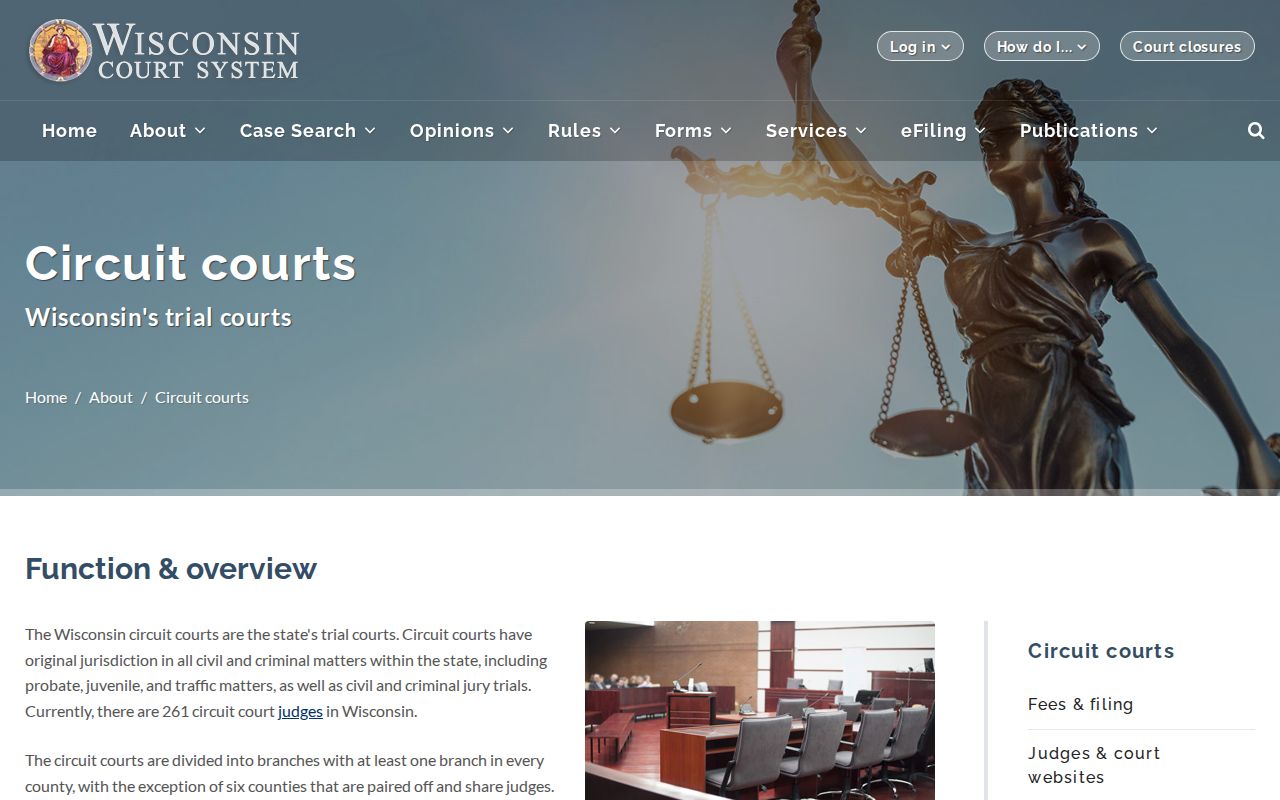
Small claims and general civil matters both sit on the Wisconsin circuit court docket.
Wisconsin Small-Claims Dockets Stay in Circuit Court
Small claims has its own procedures and codes, but Wisconsin runs it as a Circuit Court division under Chapter 799. The docket sits in the county circuit case system, not a lower trial court. For the case file, a court date, or a judgment copy, the Clerk of Circuit Court is the route.
The statutory limits depend on claim type and filing date. For qualifying actions through December 31, 2026, ordinary money claims generally cap at $10,000, while tort or personal-injury claims generally cap at $5,000. Eviction has no dollar limit. Replevin rules vary. 2025 Wisconsin Act 105 raises selected § 799.01 limits to $15,000. That applies to actions or claims on or after January 1, 2027. The tort cap stays put.
Before relying on any limit near the effective-date change, read the current Wis. Stat. § 799.01. Check the official Wisconsin small-claims guide too.
Settings and Hearings on Civil Dockets
A Wisconsin civil setting can show up three ways in case detail. It may be a future date, a past appearance, or a dated activity line. A motion hearing, status conference, or trial setting tells you what the court scheduled. It does not tell you whether the event happened or how the judge ruled. For that, read the later Wisconsin docket activity. Look for an adjournment, a new date, an order, or a final resolution.
The statewide WCCA Calendar filters circuit-court settings by county, court official, and date range, with a traffic-only option. It offers court-calendar and noncourt-calendar modes too. Which Wisconsin officials appear depends on the county and route you pick. So no fixed list can replace the live docket search. When a new date matters most, the filed notice or order is the direct, case-specific source.
Conflicting online entries happen. Trust the filed notice, or call Wisconsin court staff to confirm. The calendar is a convenience index, not a live guarantee of every change. The separate court calendar search section walks through settings and date checks in more depth. Note: the posted calendar can lag behind a filed notice. Confirm any date change with the originating court before you rely on it.
Read Wisconsin Civil Docket Events Before Judgment
A judgment heading in a Wisconsin civil case is not always the last word. Read the dated events first. One motion may have been decided before judgment. A dismissal might cover a single claim. A later entry could address satisfaction or another issue entirely. Wisconsin case status is just a broad label. It cannot replace the order or judgment that actually states what the court decided.
When the online detail lists a monetary judgment, lien, or satisfaction, note the judgment date and the newest activity. Wisconsin WCCA's docketed civil judgment search covers currently docketed judgments. It also covers some earlier ones with expired liens. Judgments never docketed are left out. A search result is not a certified Wisconsin document either. So it may not prove the judgment's terms for a transaction or a court filing.
Check the paper behind the event. A Wisconsin “Judgment entered” entry summarizes an event; ask the Wisconsin county clerk for the signed judgment or satisfaction when the exact terms matter.
Read any later satisfaction entry alongside the Wisconsin order, never as a substitute for it.
Public Access to Civil Dockets
Wisconsin leans toward open records, but access still has limits. The Wisconsin Public Records Law, Wis. Stat. §§ 19.31–19.39 sits alongside judicial rules, confidentiality statutes, WCCA display policy, and local court procedures. It does not throw every civil case open. Family, juvenile, child-welfare, probate, and protective matters can restrict particular records or fields. Protected identifiers may be redacted even in a public case.
For a Wisconsin circuit court file, start with the county Clerk of Circuit Court. A blanket request to a central state office will not reach the office that actually holds the case. The ordinary case-file route and a formal public-records request are related steps. But they are not the same thing.
Wisconsin court-record rules:
Wis. Stat. § 801.19 requires redaction or protected handling of specified personal identifiers.
Wis. Stat. § 801.20 identifies records and documents that are confidential by statute.
Wis. Stat. § 801.21 sets the motion process for a judge to seal a court record.
Wis. Stat. § 48.396 and § 938.396 restrict child-welfare and juvenile court records.
Wisconsin's public WCCA case detail can display a "Documents" label even when nothing is available online. A public docket entry and the court file itself follow different access rules.
A Wisconsin Civil Docket Is Not the Complaint
A Wisconsin civil docket event, a pleading, an order, and a judgment are four different records. The event line says a motion was filed or judgment entered. The filed paper holds the arguments or the terms. A satisfaction marks a later status of a judgment. A transcript captures what was said aloud. Getting into the court file may mean inspection first, then a copy request, then separate certification steps.
| Record | What it tells you | How to follow up |
|---|---|---|
| Wisconsin WCCA docket event | Date and short description of a filing, hearing, order, or result | Open the case detail; contact county clerk if the event is missing |
| Complaint or motion | Claims, requested relief, or a party’s position | Request the filed paper from the county case file |
| Signed order or judgment | The court’s ruling, obligations, or amount | Ask the Clerk of Circuit Court for an official or certified copy |
| Transcript | Record of spoken proceedings | Ask the clerk how to reach the court reporter |
Each county sets its own rules for counter inspection, mail or email requests, phone help, and public terminals. So follow the local Wisconsin clerk instructions. The Wisconsin statewide Clerk of Circuit Court directory or the county directory will point you to the right office. Ask about retrieval time and copy charges before you file a request. Note: Wisconsin case detail locates a civil record. The county case file supplies the actual paper and any certified copy.